How founders in Waterloo Region get from an idea to real investment, told through nine companies on Builderloo, with the programs, free money and funds at each step.
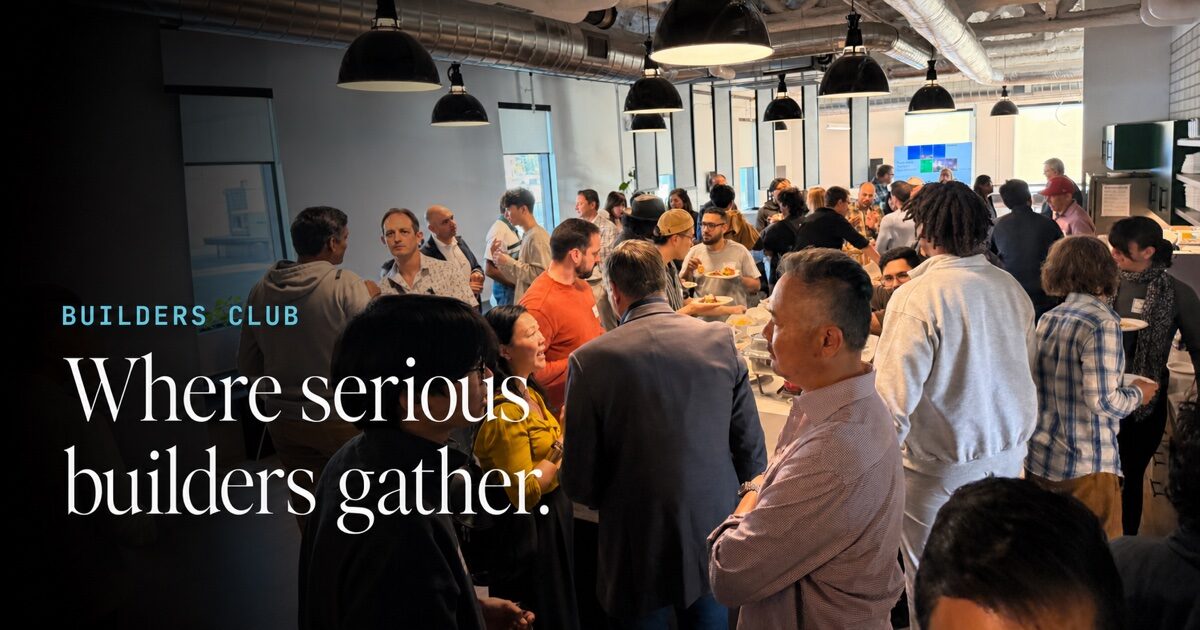
The third floor of Builders Club during a fireside chat at Waterloo Agentic
This one is for students and solo founders who can already build. Making the thing is the part you are good at. Who to show it to, where the first money comes from and when an investor will take your call are the parts nobody teaches in a lecture.
Waterloo Region has done this many times, and most of it is written down. I compiled the public stories of nine companies listed on Builderloo, from a student project that became an indoor mapping company to a PhD student who built an eye screening device on his own. Their paths follow the same five steps, and almost every step before the first real cheque was free. Program details change every term, so everything here was checked in fall 2026.
9companies whose stories I followed
9found their first customer in person
$0equity taken by the campus programs and main hubs
Step one: build it with the people who will use it
Lauren Hasegawa was a civil engineering student at Western when she saw a construction punch list written by hand in 2009. She started Bridgit with Mallorie Brodie, a business graduate. Neither was a developer, so they went to construction sites and talked to the people who would use it.
“
Five hundred interviews later, we had it.
Mallorie Brodie, Bridgit, to Communitech News
Jana Tian and Sam Dugan met at Entrepreneurs First in 2023 and started Upside Robotics in 2024 to cut fertilizer waste in corn fields. Sam built the first robot in two weeks. It was a remote control car they drove by hand to collect data and show farmers what it could do. They lived in a camper trailer at the edge of the fields, and the first season covered 70 acres.
Pablo Molina and Faizan Sheikh met in first year Waterloo engineering and wanted to build a snow removal robot. A snow contractor talked them out of it and pointed at the Walmart next door, which cleans its floors every night. Avidbots now makes floor cleaning robots.
In all three, the first real conversation changed the product. I can relate to this from my own experience designing Builderloo.
Step two: find your first users close to home
All nine found their first customer in person, and usually nearby.
Hongwei Liu started Mappedin in 2010 in UW's VeloCity residence for student founders, where his group came up with an indoor version of Google Maps. Tony Niederer at Communitech introduced the team to the general manager of Conestoga Mall. After a ten minute demo, the mall asked whether it could have it before Christmas.
Rachel Bartholomew started Hyivy Health on her own in 2019, after her own treatment for cervical cancer at 28, and ran her first clinical trials with Grand River Hospital's cancer centre and McMaster. Connor Kapahi ran research trials of Mandel Diagnostics' eye screening prototype at UW's School of Optometry while still a PhD student. Clearpath Robotics, started by four UW students, says it had five purchase orders from research groups before it built its first robot.
The cheapest place to find early users here is a room. Builders Club in downtown Kitchener runs Technical and Non-Technical Wednesdays at noon that anyone can attend, Revenue Tuesdays and a monthly Demo Night, and students who are building can join for $100 a term. DevHouse runs demo nights, Socratica holds weekly student build sessions, and Startup Drinks KW and Communitech's Startups & Beer run after work. They are all on the events calendar, with meetups and hackathons on their own pages.
Noah Deskin and Steve Hanov at Builders Club, where they met
Once your company is listed on Builderloo, claim its page with "Own this startup?". Then you can edit it, point it at your careers page so your roles show on Jobs, and post what you made on the forum's Show list. If yours is missing, write to me through the contact page.
Step three: programs and free money
The campus programs here take no equity, and neither do the main hubs.
At UW the path usually runs through Velocity. Enterprise Co-op lets an undergraduate count a full 16 week co-op term as work on their own company. The Velocity incubator in Kitchener is free, takes no equity and is open to founders who did not go to UW, but every founder has to be full time, and it accepts about one applicant in ten.
At Laurier, the StartUp Lab takes students, alumni and community members and asks for a clear problem rather than a business plan. At Conestoga, Venture Lab for Tech gives students and alumni a 15 week roadmap, a coach and desks at Communitech. Its January 2027 cohort closes applications on November 20, 2026. Once you have incorporated, the Accelerator Centre takes applications every month for AC:Incubate and takes no equity.
Early money that takes no equity, fall 2026
AC:Studiomatched, for UN sustainability goalsup to $100K
Futurpreneur loanages 18 to 39, plus up to $50K from BDCup to $75K
Velocity Momentum Grantstudents and recent grads$10K
Velocity Pitch Competition2026 top prize$5K
Enterprise Co-op family awardtwo a term$5K
The Accelerator Centre's mentors on stage at Meet the Mentors
The nine leaned on this money. Rachel Bartholomew won $25,000 at Communitech's Fierce Founders Bootcamp in 2020, then joined Velocity's first medical technology program.
“
I like to say that these programs kicked my butt.
Rachel Bartholomew, Hyivy Health, to Communitech News
Evercloak began in professor Michael Pope's UW lab in 2015 and spun out in 2018, when the Waterloo Commercialization Office paired him with Evelyn Allen, who became CEO. Its first money was a $25,000 OPG Ignite prize. Intellijoint Surgical started as a fourth year mechatronics capstone in 2010, won a provincial pitch competition and moved into the Accelerator Centre.
After incorporation, NRC IRAP pays back part of eligible research costs, and the SR&ED tax credit refunds 35% on up to $6 million of research spending a year. Several firms on the services list file it for local founders.
Step four: the first cheques
The first investor money usually comes once there is something to point at: a pilot, a trial or a few paying customers.
Velocity Fund, backed by UW's endowment, writes scout cheques of $25,000 and core cheques from $100,000 to $1 million, and promises an answer in two weeks. Builders Club's own fund, Barn Ventures, writes first cheques of US$50,000. Ground News, started by siblings Harleen Kaur and Sukh Singh out of Velocity, counts Velocity Fund, Techstars and OCI among its backers.
The first proper round is usually a pre-seed on a SAFE: investors put money in now and get shares at the next priced round. runQL raised $1.6M on SAFEs in 2024 with four business customers, led by Mistral with MaRS IAF, Inovia and Velocity Fund. Page raised $1.4M that April, led by Ripple with Garage Capital and Velocity Fund. Hyivy raised a $1.1M pre-seed in January 2022 with Velocity Fund in it.
The fastest pre-seeds went to second-time founders and senior operators, like runQL's Rob Darling and Page's founders from Shopify. Students who raised did it through Velocity, as Scribenote did after Ryan Gallagher started it as a UW engineering student in 2019. The free steps above are how a first-time founder earns that track record. My story on the funds that invest here has every fund and what it backs.
Step five: priced rounds
A priced seed round sells shares at a set value, usually led by one fund. The lead often comes from Toronto or the US, with local funds following.
Real rounds from these stories, in CAD
Mappedin, 2026US$24.5M Series B$33.8M
Avidbots, 2019Series B$31.5M
Scribenote, 2024seed led by a16z$11M
Upside Robotics, 2026US$7.5M seed led by Plural$10.4M
Page, 2025seed$4.1M
Intellijoint, 2013led by MaRS IAF$3.3M
Evercloak, 2024seed$2M
runQL, 2024pre-seed on SAFEs$1.6M
Mappedin, 2014seed$1.51M
Page, 2024pre-seed on a SAFE$1.4M
Hyivy, 2022pre-seed$1.1M
Upside's seed came when it had gone from 70 acres to 1,200, with more than 200 farms on its waitlist. Page closed its seed about ten months after its SAFE, and Clio bought the company in October 2026.
2010
Mappedin starts in UW's VeloCity residence, and Intellijoint starts as a capstone project
2013
Intellijoint raises $3.3M led by the MaRS Investment Accelerator Fund
2014
Avidbots moves into Velocity's hardware space, and Mappedin closes a $1.51M seed
2016
Bridgit raises a US$1.7M seed after its angels
2019
Avidbots raises a $31.5M Series B
2022
Hyivy raises a $1.1M pre-seed
2024
Evercloak closes a $2M seed after its demonstration units
2026
Upside raises a US$7.5M seed, and Mappedin announces a US$24.5M Series B
What the region did for them
Introductions come up first. Communitech introduced Mappedin to its first customer, WatCo introduced Evercloak's founders to each other, and Connor Kapahi gave an impromptu five minute pitch at Velocity that led him to suppliers he had chased for months.
“
It's hard to put a price on free space, mentorships and the connections that were made there.
Pablo Molina, Avidbots, to UW News
People here also put money back in. The Clearpath founders invested in Upside, and a Velocity founder backed Ground News. Mallorie Brodie said Bridgit moved here in 2013 knowing almost no one and "basically just showed up on their doorstep" at Communitech.
Bring the rough version of what you are building and show it to one person who might use it. Then look through the startups that came before you, the hubs and funds that backed them, and the people doing it now. When you have something to show, post it on the forum. I'd love to write the next one of these about you.
Our fully autonomous floor scrubbing robots — Neo, Neo 2W, & Kas — thrive in commercial spaces. Contact us to see an Avidbots robot floor cleaner in action!
Robotics & HardwareB2BHardware
Velocity, Communitech, University of Waterloo · 11-50 employees · since 2013
Bridgit is a leading provider of construction resource management software, helping construction teams optimize workforce planning and project delivery.
B2BSaaSEnterprise & Business Software
Velocity, Communitech · 51-200 employees · since 2012
As the world’s population continues to grow, the demand for sustainable energy, clean water, and food intensifies. Meeting these essential needs without accelerating climate change is one of humanity’s greatest challenges.Our vision is to leverage cutting-edge graphene technologies to reinvent the…
Energy, Climate & SustainabilityB2BHardware
Velocity, Communitech, Accelerator Centre · 11-50 employees · since 2018
A selected membership and clubhouse in downtown Kitchener for founders, operators and students making something real, with Wednesday sessions open to anyone.