The two Laurier founders met in Portugal, built a hiring tool that shows candidates where they stand, and brought it home to Waterloo Region.
Shahzeb Atif and Dea Sokoli, right, on stage in Porto with their European Innovation Academy teammates and the Top Team sign
Shahzeb Atif found Builderloo by asking an AI. He had Perplexity looking for events in Waterloo and Toronto that he and his co-founder should go to, it pointed him at the events page, and a few clicks later he was on the startups list writing me a note through the contact form. A few days after that, on Tuesday morning, I met him and Dea Sokoli for coffee at Balzac's in Communitech. Before they arrived I had signed up for Ascent to try it, which got a laugh, since I'm not hiring anyone. Yet.
Ascent is an applicant tracking system, the software a company uses to post a role and move people through interviews. Most of those tools are built to make recruiters faster. Ascent is built for candidates first, so they can see where they stand, and recruiters still get tools that are easy to use.
top 10of 75 teams at the European Innovation Academy in Porto
top 10 (again!)of 100 teams at Velocity's pitch competition
50+Recruiters and business owners spoken to
2 monthslive, pilots underway
Who they are
Shahzeb Atif crossed the convocation stage at Wilfrid Laurier University in October, a few months after he wrapped up a double degree in computer science and business. Five internships showed him how companies work from the inside, among them a co-op at Miovision in Kitchener working on the company's AI tools, and this fall he started the MBET program at the University of Waterloo. At Ascent he is the CEO, and he writes the code.
Dea Sokoli is finishing her business degree at Laurier's Lazaridis School, and she has packed a lot around it: operations at FluidAI Medical, a medical technology startup, a term on sales strategy at McCormick, running logistics for Laurier's orientation week, and a women's health project that earned her first bit of funding through Laurier Changemakers. At Ascent she is the COO, and the look of the site is hers. She made sure I noticed the little sun that rises over the logo when you switch out of dark mode, the kind of detail most teams would never bother with. Great design taste!
The application black hole
The idea started with Shahzeb's own job search. This year he graduated with five internships and a double degree, and when he applied for new grad roles he heard back from very few of them. He wasn't alone. Shahzeb told me that 94% of applicants don't hear back after they apply. I knew the feeling. I sent out about 150 applications this fall and got two or three interviews out of them.
Shahzeb and Dea had both worked in talent acquisition, so they had also seen the other side. Inside a company, the recruiters can see exactly where every candidate stands. None of that reaches the candidates, Shahzeb said, because hiring tools are built for the people who pay for them, and that is the recruiters.
A candidate's view of a role on Ascent, with each interview stage as a camp on the mountain
In Ascent, a role is a mountain and each interview stage is a camp. A candidate sees their own climber, and, anonymously, how many people are ahead of them, beside them and behind them. They see when a recruiter opens their application. When a candidate is rejected, Ascent drafts an email comparing their application with those further along in the process, to help them become a stronger applicant, and the recruiter reviews it before it goes out. Recruiters remain in control, and a recruiter who doesn't want AI-written letters can send a plain one instead.
“
You actually stay in the loop, regardless of the good or the bad.
Shahzeb Atif
Shahzeb said that even bad news early is worth something. If other people are moving and you aren't, that's an early sign, and you don't have to sit on your hands for weeks waiting to find out. He also brought up the mental health and burnout that come with a long job search, and he and Dea think applicants should be treated with more dignity.
Ask before you apply
The feature everyone likes, Shahzeb said, is the question board. Every role has a public board where applicants ask questions and the recruiter answers once, for everyone.
I told them about a front-end role where I made it to the final stage, and then heard that I didn't know enough SQL, a database skill no one had asked me about in any interview. Shahzeb's answer was that this is what the board is for. If someone had asked up front whether the role was SQL heavy, and the recruiter had said yes, I could have decided whether it was worth my time before I spent it.
6,000 Kilometres to Meet a Classmate
Every year Laurier sends five business students to the European Innovation Academy, where students from around the world spend three weeks building a startup from nothing. This summer the academy was in Porto, and that is where Shahzeb and Dea met. The idea for Ascent was Shahzeb's, and Dea joined in by telling him she had felt the same pain points herself.
The funny part came after they got home. It turned out they had been in the same law and entrepreneurship class at Laurier the semester before and had never met.
In Porto, Ascent made the Grand Pitch as one of the top 10 teams, out of 75 teams and around 300 students. Their mentors there pushed them to care about recruiters as much as candidates, since recruiters now sort through far more applications than they did a few years ago with tools that haven't kept up, and they lose good people, and some of their company's good name, along the way.
Two hours to pitch
Back in Waterloo, Dea got a call one weekend in September telling her to get ready to pitch at Velocity's pitch competition. She had less than two hours to prepare and memorize a tight script, with no slides, for a room of 100 teams and 100 mentors. She made the top 10. She wrote afterward that being able to speak on a topic at the last minute is a sign of how much you've put into it, and after three weeks building Ascent in Portugal and a month of talking to people in HR, she knew she was ready.
Dea pitching Ascent at Velocity's pitch competition
“
Being able to get up in front of a crowd and speak unabashedly for two minutes on a topic at the last minute is a signifier to the dedication you've put towards that topic.
Dea Sokoli
Starting Small, on Purpose
Ascent is running pilots now with a few small organizations and clubs. Its first real role went up the night before we met, a social media and video internship for a business owner they met at an event that Friday. Shahzeb and Dea want to reach small businesses that hire part-time and volunteer roles, don't have anyone in HR, and can't justify a few hundred dollars a month to post a job on LinkedIn. Ascent's free plan covers one open role and 25 candidates.
Ascent also sells a single role, for companies that only hire a few times a year and don't want a monthly subscription.
Next for them is getting it in front of people, signing up clients, and turning those pilots into case studies. Most of their leads so far are warm introductions. Shahzeb said you hand out ten business cards at an event, and even when the person isn't the right fit, they have a brother or a friend who is.
Dea and Shahzeb at Ascent's booth at KW BizCon
Building from Laurier
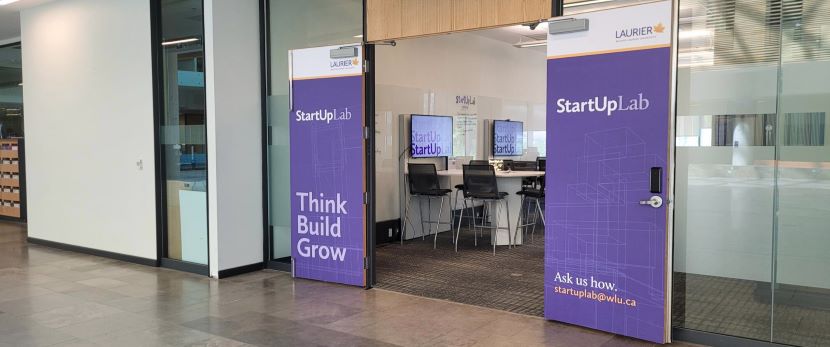
Ascent is part of Laurier's StartUp Lab and Velocity. Dea thinks university is one of the easier places to start something, because of the mentors, the clubs and the patience people have for a student who is still figuring it out. Laurier has already invited the two of them back as keynote speakers.
Dea and Shahzeb at Laurier, each standing under the other's photo on the Keynote Speakers slide and pointing at it
Shahzeb would like StartUp Lab's founders to be better known around the rest of the region, and he is happy for Ascent to go first. I'm all for it. The newest companies here are often the hardest to hear about, and a lot of why I built Builderloo was to put founders like these where people can find them.
“
So we're trying to change that. Even if we're the first ones, we'll do it.
Shahzeb Atif
You can find them around the region. They go to Locally Connected, a regular meetup of small business owners, and they will have a booth at K-Dub Hacks, the 48-hour hackathon at SPUR, from November 27 to 29. I'll be there too, and I'm looking forward to stopping by their booth.
Ascent on Builderloo
You can find Ascent on Builderloo at its profile. I'm also working with them on bringing roles posted with Ascent onto Builderloo's jobs page, and on sharing what I know about how the region's startups hire, so the two sites can help each other. And if you're job hunting, have a look at the open roles on Ascent. Every one has its own question board, so you can ask the recruiter what you want to know before you apply. I'll update this story when their jobs show up here.
Ascent is an applicant tracking system built around one thesis: candidates should never be left in the dark. Browse open jobs, or hire with every step visible.
Miovision focuses on solving today's and tomorrow's real-world traffic problems. Learn more about a future-proof solution that evolves with your city’s needs.
B2BGovernment & Public SectorGovernment & Civic
Communitech, Accelerator Centre, University of Waterloo · 51-200 employees · since 2004
Wilfrid Laurier University's incubator in Lazaridis Hall, Waterloo, for Laurier students, alumni and community members turning an idea into a business.