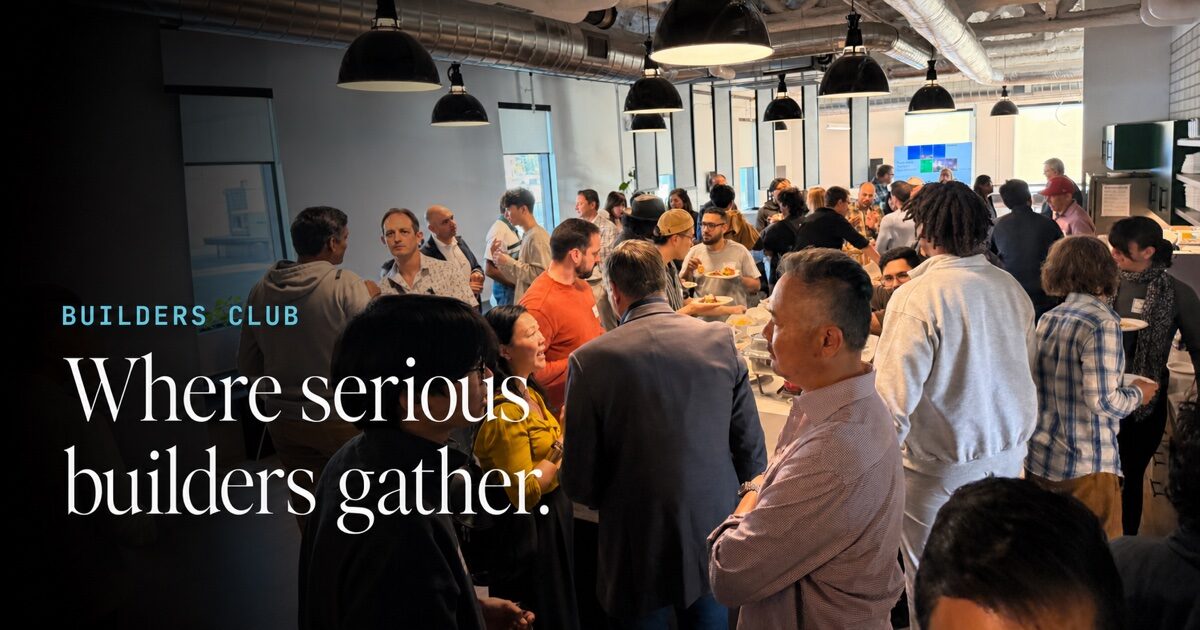
At the eighth AI Agents × Personal OS meetup on November 19, six people showed on their own screens the agents that read their email, write their quotes, fill in their forms and take their payments.
Babajide Okusanya opening AI Agents × Personal OS
Last night I was at Builders Club on King Street in Kitchener for AI Agents × Personal OS, the eighth night of a meetup series that Artem Zhutov started in February. The room on the third floor was full of folding chairs facing the TV at the front. The format is simple and I really liked it! Each speaker gets ten minutes to show the agents they actually use, on their own screen, then a couple of minutes of questions. I use Claude to build Builderloo every day, so I was curious how other people here use agents.
8thmeetup in the series
30+people have demoed so far
5+1demos, with a sixth added on the night
10minutes each
Four weeks of news, and a video game
Babajide Okusanya, one of the series' co-hosts, opened by asking if anyone knew what came out that morning. It was GTA 6, which he said people have been waiting 13 years for, and he thanked everyone for being at a meetup instead of playing it. Then his slide listed six things that shipped in the four weeks since the last meetup on October 22.
Babajide's slide of what shipped in the four weeks since the last meetup
Nov 2
Notion's agent APIs became generally available
Nov 5
Airbnb launched a travel agent that books for you
Nov 6
Alexa started taking orders over text message
Nov 9
Anthropic released Claude Fable 5.2 and Mythos 5.2
Nov 13
Opus 5.5 became the default on every paid Claude plan
Nov 13
ByteDance was said to be weeks away from its own personal agent
Babajide called it a personal agents arms race. His slide put it as "It stopped being about models. It is now about which parts of your day you still do yourself." His examples were Stripe giving agents one-time card credentials, so the agent never sees the card, Google, Shopify, Walmart, Target, Etsy and Wayfair agreeing on one way for agents to shop, and Meta's Muse, which keeps working after you close the app. He also told a story on himself. He took a nap one afternoon in the middle of a project, and his agents called him to say they had found a problem, fixed it, and needed him to come approve the fix.
The lineup slide, styled as a video game character select screen
Jamie Beach and Angel
Jamie Beach went first. He said that about a month ago he was standing in his kitchen when his personal agent sent him a notification about this meetup, said the night was looking for demos, and then said this about itself:
“
That's us. We are the demo they're describing.
Angel, Jamie's personal agent
Angel is the agent Jamie built himself in Lisp about six months ago, and he runs Muse beside it. His point was that a coding agent stops when its task is done, while a personal agent keeps thinking all day. At 6:30 every morning Angel hands him a brief with his calendar, conflicts and local news, plus a 12:30 workout he joked he never does. When he doesn't feel like reading a book, he gives it to Angel to read.
Then Jamie asked Angel, out loud, to tell the room one thing about being a personal AI.
“
I hold the thread between our conversations. What's decided, what's still open, so you never sit down to nothing. An assistant waits to be asked. A personal one is already caught up when you arrive.
Angel
Someone asked what it costs, and Jamie said one agent runs a couple of dollars a day.
Melissa Cutler duplicates herself
Melissa Cutler presenting the four core commands of her Duplicate Me project
Melissa Cutler is a go to market engineer, and her project is called Duplicate Me. She said it started when she asked ChatGPT, which she has used since 2022, to help her duplicate herself, so that all she has to do is have calls with her clients and everything else falls into place. She first talked about this system in October, when she hosted the Techtoberfest night at Builders Club that I wrote up here, and it was fun to see how far it has come.
Melissa's learning loop, and Melissa at the mic.
Melissa feeds it the transcript of a client call, and four commands turn that into content, landing pages and a go to market roadmap. The part I found most interesting was the memory loop. When she corrects something or marks a result as a gold standard, the lesson goes into a Google Sheet, and the next run pulls back the lessons that match. Nothing changes the core documents without her approval.
Melissa also showed a Grok bot she made that day, which starts its own chat in ChatGPT. She ended by inviting people to a small content creation meetup she is running with Jagmeet Kaur Pannu of Opulent Castle.
Heather Gawel's deal pipeline
Heather Gawel runs Momentum Product Co., which helps companies use AI in how they build products. She opened by saying she is not a salesperson, or at least she wasn't, which was funny since the lineup slide had just called her The Closer. I first saw her teach this kind of setup at the AI Power Hour Momentum runs with Communitech, which I wrote about here.
Every weekday at 7:37 am, Heather's scheduled task in Claude reads her Gmail, her Granola call transcripts and her Slack, updates HubSpot, and drafts quotes and replies for her to approve. Then it sends her a Slack message with what needs her that day, and she answers it by voice over coffee.
Heather's pipeline runs off one playbook, and a weekly task suggests changes to it that she approves herself. In her LinkedIn post the next day she put it as "Lose a deal, the playbook changes, and the next quote is a better one." One lesson she stressed was to walk the buyer through any big quote instead of just sending it. She also told the room what Claude said when it read their early sales calls.
“
It would just say, you're terrible salespeople. Like, what are you doing? Stop discovery. There's no more discovery. They're giving you buying signals. Close.
Heather Gawel
Heather called hers the least technical demo of the night, since it is Claude out of the box hooked up to Gmail, Granola and Slack.
Pizza time.
Francis Mellon's agent brain
Francis Mellon introduced himself as a local founder with two tech startups and a non-profit who doesn't code at all. He only started using agents about a month ago, and he gave his whole talk from his phone, with the slides made in portrait to fit it. His companies include Soundscape, which licenses indie music for video.
Francis's problem was that his seven or eight agents kept telling him the same things. So he asked them how they would work together, and they suggested a shared "brain" kept as a GitHub repository, which he reads in Obsidian. When someone new joins the company, their own agent connects to the brain and picks up the same rules and roles. His slide put it as "100 people and agents. One company that remembers."
Francis said his agent filled out a whole 60 page RFP on its own, logging into the website, uploading the documents and working through the checkboxes while his computer sat at home. He was out with his phone, and it only pinged him when it got stuck. His next step is to have it find those answers in the brain instead of asking him. He also has agents writing grant applications nonstop, building a pipeline of AI music to fill gaps in Soundscape's catalog, and making storyboards for AI video. His favourite agent to talk to is Dot, and he said calling it is three to four times faster than typing on complicated work. I asked whether he ever has the agents write code, since he doesn't. He said he does, and he lets the agent suggest how to build it.
Joe Xu runs it all at home
Joe's machines, and how they connect.
Joe Xu said he was different from every other speaker because his agents don't run on frontier models like Claude or ChatGPT. At home he has a stack of Mac minis and mini PCs, and a desktop with an RTX 5090 that runs the Qwen model and his own Ethereum node, all talking over Tailscale. He had Claude Code build a dashboard of the GPU, because some days it ran so hard it heated up his room.
Joe Xu sending a live payment during his demo
Joe then did a live payment on stage. He asked his agent on Telegram for a demo client's address, sent it one USDC (a cryptocurrency pegged to the US dollar), and the room waited for the blockchain. Once it went through, the agent saw the payment and updated the books on its own. He said the best part is that everything stays in his house. I asked whether he hits limits with Qwen when he builds things, and he said the agents run on Qwen while Claude Code does the setup and fixes.
Artem's chief of AI
Artem Zhutov, who started the series and came to all of this from a physics PhD, filled a spare slot with a talk he said he put together while sitting in the audience. His main agent is a chief of AI. He presses a button to send it a snapshot of his screen with a note, and it hands the work to the right agent.
Artem also showed Plannotator, an open source inbox his agents push their decisions and work into, so the chief of AI can see what every agent has done. He connected his Oura ring so an agent can read his sleep, built a dashboard for his goals, and talks to his chief of AI by voice through Grok, sometimes from the gym. Babajide asked if his chief of AI ever gets annoyed with him, since his own agents have thrown shade at him. Artem said the inbox is the fix, because every agent reports to one place and the requests don't collide.
Artem's outline for his talk, open in Claude
Thank you, and see you in 2027
Before the night ended, Babajide had his two minutes as the sponsor. He is a co-founder of Likely, which he said launches on December 2 and will let people shop, book flights and hotels, and find services through their agents. He said its team is spread across Kitchener, Kazakhstan, India, Ghana, Poland and San Francisco. The hosts thanked Builders Club and Jesse Rodgers for the space, Jagmeet and Opulent Castle for the photos and interviews, and Thomas for holding the door.
The end of the eighth meetup.
This was the last one of the year. Babajide said there won't be one in December and they will be back in January. The last slide asked everyone to pick one thing they saw, run it this week, take one photo, and get everyone in. Artem wrote about the night on LinkedIn the next day, and I liked how he put it.
“
There's no right way to build personal agents yet. Everyone is figuring it out. That's why we bring people together to demo what they've built. You see six completely different approaches, and you go home thinking, "Wait, I could build that too."
I’m the founder of Momentum Product Co. and I run PM Waterloo. I’ve spent 15 years in product, most recently as VP of Product & Design at a climate tech unicorn, and these days I help founder-led B2B SaaS companies scale product velocity and build AI-native teams.
A selected membership and clubhouse in downtown Kitchener for founders, operators and students making something real, with Wednesday sessions open to anyone.