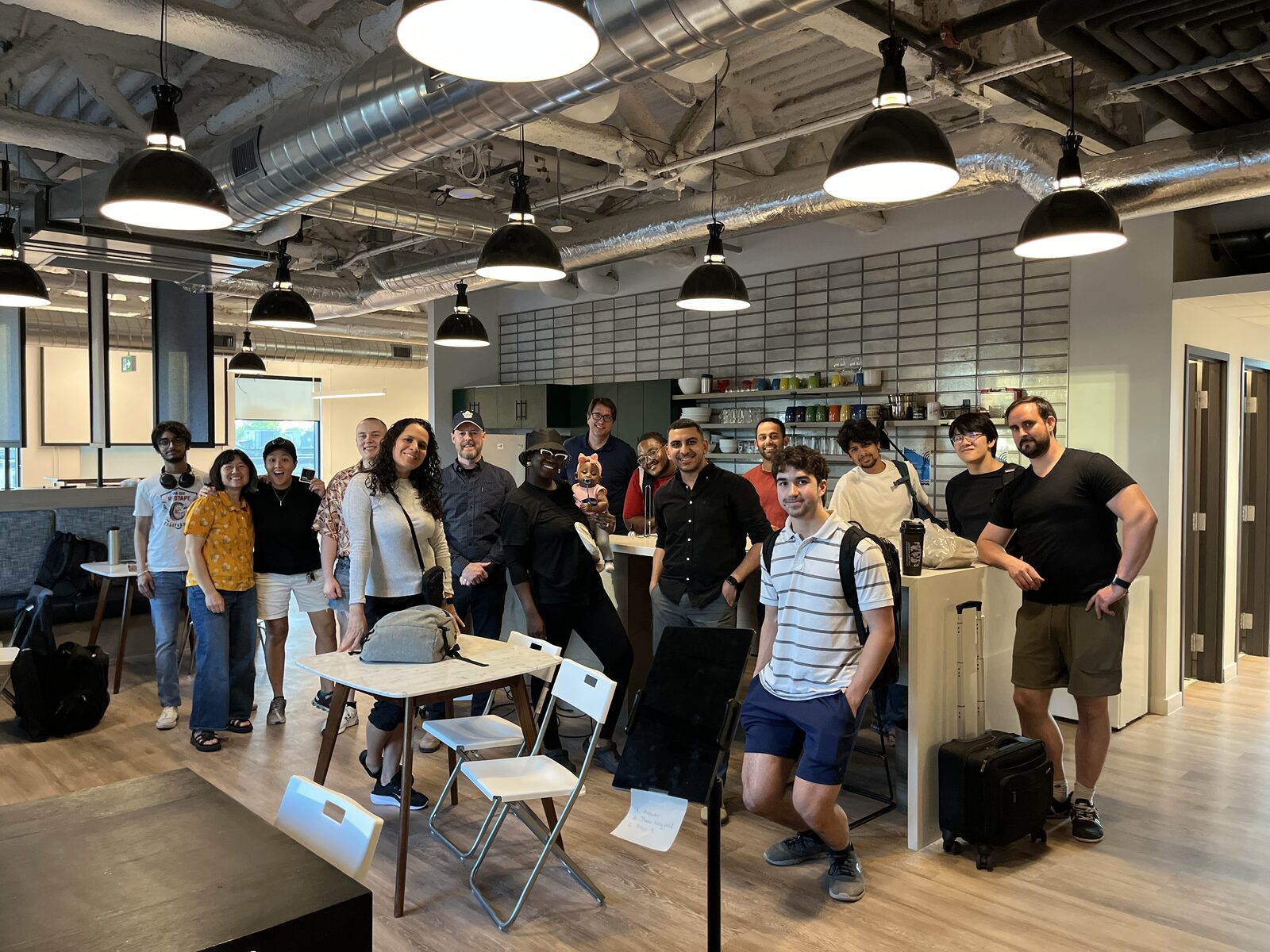
Heather Gawel and Babajide Okusanya of Momentum Product Co. spent an hour on November 4 showing a room of founders how to build a small team of AI agents, and how much to let them touch
Heather Gawel at the front of the room with the night's plan on the screen, 25 minutes of slides and then you build
On Wednesday night I went down to Communitech for AI Power Hours: Hiring your first 5 AI employees. Nearly every table had a laptop open. I use Claude Code all day to build Builderloo, so I didn't need convincing. I wanted to see how other people do it properly, and I don't love the word "employees", since mine are really just a bunch of skill files.
What I didn't know until I sat down is that this is a series of four that Momentum Product Co. runs with Communitech.
4Power Hours in this series
5AI employees, each with one job
25minutes of slides
35minutes to build your own
Who ran the night
Communitech opened the night by thanking Google for Startups, which sponsors all of the Power Hours, and then handed it to Heather Gawel.
Heather has spent 15 years in product, and a lot of her work now is helping teams figure out what to build. She also runs PM Waterloo, a group for product managers that usually meets at Builders Club every month.
Babajide Okusanya is Momentum's technical AI lead, and he ran the hands-on half with her. He also co-hosts AI Agents × Company OS at Builders Club.
What makes it an agent
Heather started with the difference between an agent and a chat you run on a schedule, and I liked how simply she put it.
Scheduled task
Agent
What it is
A prompt that runs at a set time
A worker with one specific job
What guides it
One request, every time
Its own rules, and it knows when to stop
What it can touch
Hard to limit
Only the files you name, read or write
A skill, as Heather explained it, is a set of instructions you save for something you do over and over. The part that surprised me is that she doesn't type them out.
“
You don't actually have to write your own skills.
Heather Gawel
Heather holds down a key, talks to Claude about how bookkeeping works in her business, and lets it ask her about whatever is missing. Then she dropped one zip file into the plugins section of Claude's desktop app, which she called "this next beautiful area that no one ever uses," and had a working team of four agents.
The bookkeeper, on made-up invoices
Heather's demo used made-up invoices and quotes, and I really liked how easy she made it to follow. Each agent gets one job and a short list of what it can touch, and the bookkeeper can only change the expenses file. Here is what happens when an invoice comes in.
In
The invoice lands in the incoming folder
Check
The bookkeeper finds its quote and checks the math and the HST
Log
If it's new, the bookkeeper adds it to the expenses file
Sort
The chief of staff decides what needs you
You
The short version shows up on your phone
Heather showed us a run she had set for 8 AM every day, and I liked seeing what it had done on its own. One invoice was over its quote, one looked like a duplicate, and one had a delivery fee on it.
The email with Roblox in it
This was my favourite part of the night. Someone asked what kind of misses she'd had with Claude sending email, and Heather told us about dictating a reply by voice while someone nearby was talking about Roblox. The voice tool picked it up, and a request for more Roblox credits ended up in the middle of a client email before she saw it.
So Heather's advice to anyone new is to have agents draft and not send, because client communications are "pretty sacred."
“
This is like a dispute over an invoice. So like hard no on the agent blindly sending it to somebody.
Heather Gawel
How to pick what to hand off
Heather and Babajide also gave us a simple way to pick what to hand off. You map one workflow and score each step on these four questions.
Question
3 points
1 point
How often?
Weekly or more
A few times a year
Can you write the rules?
On one page
It's a judgment call
Cost if it's wrong?
Easy to catch, cheap to fix
Hard to undo
How much access?
One system
Several systems
Anything in between scores 2. A step with 10 or more is one to hand off, and under 8 you keep it for now.
Building at the tables
For the second half the room split up, with ChatGPT at the back with Heather and Claude at the front with Babajide. I stayed at the Claude table, where I liked that Babajide started by asking what people wanted to hand off. Then he walked us through how he'd start.
Step 1
Open a normal chat and tell Claude the few agents you want
Step 2
Tell it to finish one agent before the next
Step 3
Use Claude's Opus model for this planning
Step 4
Pick a folder for them, and use Claude's Sonnet model to run them
I told Babajide that Claude always messes up some of the wording in my newsletter, so I do a lot of review. He said I could have an agent review it, and then the two of us started adding to that.
“
One that drafts it, one that reviews it, one that reviews the review, and one that reviews it before it gets to you.
Babajide Okusanya
I said you could just keep chaining them together, which is pretty close to what I've built for The Weekly.
Someone asked what happens to your agents when you close your laptop. They stop. Babajide keeps a separate computer at home for his, because, as he put it, you might want to "close your computer and go to sleep like a normal person."
What I'm going to try
My skills don't talk to each other yet, partly because a fresh agent forgets a lot of the important details when I hand it work. Heather's setup gives each agent one small job and a short list of files, so there's less for it to forget, and I'd like to try a chief of staff for the checks I already run on Builderloo.
Take it home
Heather Gawel closing the night with the last slide on the screen
Everything from the night is on Momentum's workshop page, including the slides, the agent files and a folder of sample invoices to try them on. You drop in your email to get the downloads.
That was a really fun hour, so thank you to Heather, Babajide and Communitech. If you built something at one of these, I'd love to hear what it does.
Nov 18
The third Power Hour, at Communitech, on outbound messaging on a founder's budget
Nov 19
AI Agents × Personal OS at Builders Club, which Babajide helps run
Dec 2
The fourth Power Hour, on vibe coding, from idea to build
You can sign up for November 18, November 19 and December 2 on their event pages. Both Power Hours are free for founders, and you don't need to be an engineer.
I’m the founder of Momentum Product Co. and I run PM Waterloo. I’ve spent 15 years in product, most recently as VP of Product & Design at a climate tech unicorn, and these days I help founder-led B2B SaaS companies scale product velocity and build AI-native teams.
A selected membership and clubhouse in downtown Kitchener for founders, operators and students making something real, with Wednesday sessions open to anyone.